Impact Flash!
Impact Flash! is a citizen science project where anyone with a suitable telescope and camera (including you!) can observe the Moon to search for impact flashes.
Impact flashes are split-second flares of light that are visible on the darkened hemisphere of the Moon when a meteoroid hits the lunar surface and vaporizes. We need your help to find and study these flashes during the Artemis II mission and beyond.
Science
With no atmosphere, the Moon records many more surface impacts than we can see here on Earth. By studying the intensity, size, and timing of a lunar impact flash, we can estimate the velocity and size of the object that produced it. These observations give us a better understanding of the population of the small bodies in our Solar System, and the threat they pose to the Moon (and to the Earth).
This knowledge allows us to better understand the hazards that astronauts face. Future seismometers on the surface of the Moon will also record the seismic waves produced by impact flashes, and being able to identify the timing and location of these impacts will help us to study the interior of the Moon using moonquakes as well.
Artemis II
The Artemis II mission will see astronauts fly around the Moon for the first time since 1972, and is due to launch in the spring of 2026. During their time in lunar space, the astronauts will be looking at the darkened side of the Moon to try and record impact flashes visually and using the cameras on the Orion vehicle. We need you to be looking at the same time, so that we can correlate what they see with what you see!
How to Observe
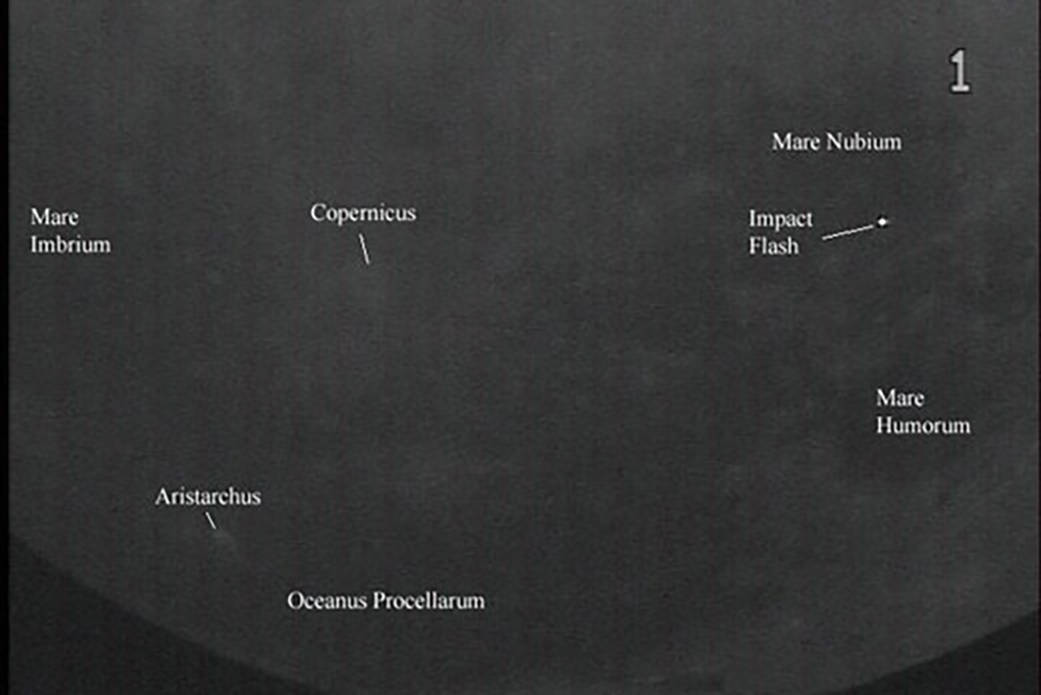
Observing impact flashes is not technically complicated, but they are rare so you may have to wait some time (hours) to see one. They are also very short, so you will need to record video through your telescope so that we can go back and check any potential flash candidates. To observe, you will need:
- A telescope, ideally equipped with automated tracking to keep the Moon in field,
- A camera, recording at least 25-30 frames per second, and with accurate timestamps
- The ability to report your location, i.e. from your phone’s GPS.
There is no single make or model of telescope or camera that is required, but we would suggest that a 4-inch mirror or lens is the minimum size required. Smaller telescopes will only observe the very largest flashes which are comparatively rare. In terms of focal length, f/6 or smaller will maximize the amount of the lunar surface that is in focus at any one time.
Your telescope will need to be pointed at the darkened hemisphere of the Moon. It is not possible to see flashes on the lit hemisphere as they are not bright enough. We would suggest that you aim as far from the terminator (the line dividing day from night) as possible.
You are welcome to look through your video yourself to try and identify flashes. Software called ALFI (available here from the University of Aberystwyth: https://users.aber.ac.uk/atc/alfi.htm) is available for this purpose. However, you will still need to upload your video (ideally in RAW monochrome format) to the LIF page: https://lif.mi.imati.cnr.it/home_page.php?status=start
Please follow the instructions on the submission portal to ensure that your video is in a suitable format for us to use, i.e. including the required meta-data.
Other resources for observers can be found at the links below:
- Observing advice from the British Astronomical Association: https://britastro.org/section_information_/lunar-section-overview/lunar-section-observation-activities/lunar-geological-change-detection/observing-lunar-impact-flashes
- Observation FAQ: https://lif.mi.imati.cnr.it/open_item_page.php?item_idk=LDB-000000004